Hospital Discharge Management: From Discharge Planning to Coordinated Care
Hospital discharge management is the process of planning and coordinating all medical, organisational and administrative steps required to safely transition a patient from inpatient care to the next stage of treatment and support.
Physicians, nurses, case managers, social services, pharmacies, transport teams and external care providers may all need to coordinate information, tasks and timing to ensure a patient can leave safely and on time.
This guide explains how hospital discharge management works, where delays typically occur and how digital coordination can make the process more transparent and predictable.
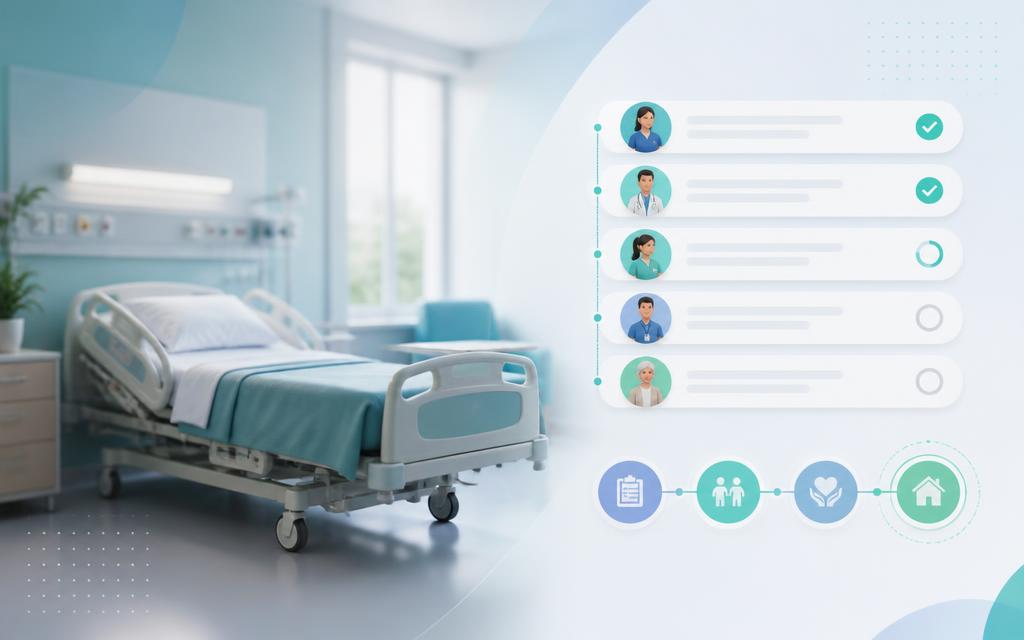
What is hospital discharge management?
Hospital discharge management covers the planning and coordination of a patient's care as they transition from inpatient treatment to the next care setting.
The goal of discharge planning is to identify what a patient will need after leaving the ward early enough to arrange it — so that treatment, nursing support and follow-up can continue without interruption.
It is a shared responsibility involving physicians, nursing staff, case management, social work, pharmacy, patients and families, and the external providers who take over care.
Discharge management is therefore far more than setting a discharge date. It connects the medical clearance decision, the operational preparation around it, and the confirmation of post-acute care.
Why hospital discharges are often delayed
A patient can be medically ready to leave while the operational prerequisites for discharge are still outstanding.
- Medical clearance still pending
- Post-acute care not yet confirmed
- Rehabilitation placement not arranged
- Home care not yet clarified
- Discharge medications not prepared
- Equipment or supplies unavailable
- Transport not booked
- Documentation for the receiving provider incomplete
- Responsibilities unclear between the teams involved
The more people and dependencies a single discharge involves, the harder it becomes to see a patient's true readiness status in real time.
Standards and expectations for discharge planning
In Germany, discharge management is a statutory part of inpatient treatment: § 39 (1a) SGB V requires hospitals to support the cross-sector transition into care after a hospital stay, assess the individual need for follow-up care and initiate the necessary measures.
The national framework agreement on discharge management (Rahmenvertrag Entlassmanagement) adds the operational detail: multidisciplinary collaboration, early needs assessment, timely initiation of follow-up services and structured information transfer to treating physicians and receiving institutions.
Other health systems formalise similar expectations through transition-of-care and discharge-planning standards. The operational consequence is the same: needs must be identified early, responsibilities must be clear, and the receiving provider must receive complete information in time.
Legal basis (Germany): § 39 (1a) SGB V and the Rahmenvertrag Entlassmanagement.
How hospital discharge management works
Identify discharge needs
During the inpatient stay, the team assesses what support and follow-up care the patient is likely to need after discharge.
Plan the expected discharge
The expected discharge date is set, together with the steps that need to be completed beforehand.
Coordinate post-acute care
Rehabilitation, home care, skilled nursing, primary care, receiving hospitals and other providers are coordinated as needed.
Prepare medications, documentation and services
Prescriptions, discharge medication, equipment, findings and the discharge summary are prepared.
Confirm handoffs and outstanding tasks
The parties involved confirm the planned care and receive the information they need to continue care.
Complete the discharge
Once the medical and operational prerequisites are met, the patient can leave and care can continue outside the hospital without interruption.
Who is involved?
Physicians
Medical clearance, diagnoses, treatment planning and the prescriptions required after discharge.
Nursing
Care needs, readiness confirmation and handover of the information the next provider needs.
Case management / social work
Coordination of post-acute care and communication with external providers and payers.
Pharmacy
Preparation and review of discharge medication, including interaction checks where required.
Patients and families
Involvement in planning, consent and the practical arrangements around continuing care.
Rehabilitation providers
Inpatient or outpatient rehabilitation placement and the timing of admission.
Home care providers
Nursing services at home, including start date, scope and equipment needs.
Primary care
The treating physician who continues the patient's care and needs a complete and timely discharge summary.
Receiving hospitals and other post-acute providers
Receiving hospitals, skilled nursing facilities and other providers taking over the patient's care.
Coordinating post-acute care
Depending on individual needs, the following care settings may be relevant.
- Rehabilitation
- Home care
- Primary care follow-up
- Skilled nursing / post-acute facilities
- Short-term nursing care
- Transfers to other hospitals
- Home health services
- Equipment and supplies
- Discharge medication
- Other post-acute providers
Digital hospital discharge coordination
Many discharge processes are still coordinated by phone, email, fax, paper notes and separate systems. As a result, it is often difficult to see at a glance which requirements have been met and where delays are occurring.
Digital tools can bring discharge tasks, responsibilities, status information and outstanding items into a shared operational view. This can make discharge coordination more transparent and provide a structured basis for identifying delays and improving patient flow. Once those workflows are consistently structured, they also become the data foundation for AI in hospital discharge management.
WardPilot adds an operational coordination layer, connected through HL7 and FHIR hospital interoperability.
Every role involved works from the same operational view: handoff information, discharge readiness per patient, open tasks and active blockers.
From discharge coordination to hospital capacity
Predictable discharge workflows are also a question of hospital capacity and bed management, and ultimately of hospital operations intelligence. When each step has a clear responsibility and status, teams can plan expected bed availability instead of relying on estimates:
- Planned discharges per ward and day
- Medical clearances granted
- Open operational steps
- Missing confirmations
- Post-acute care status
- Reasons for delay
- Expected discharge times
Frequently asked questions
Make hospital discharges more predictable
WardPilot integrates with existing HIS environments. It supports operational discharge coordination without replacing the hospital’s system of record.